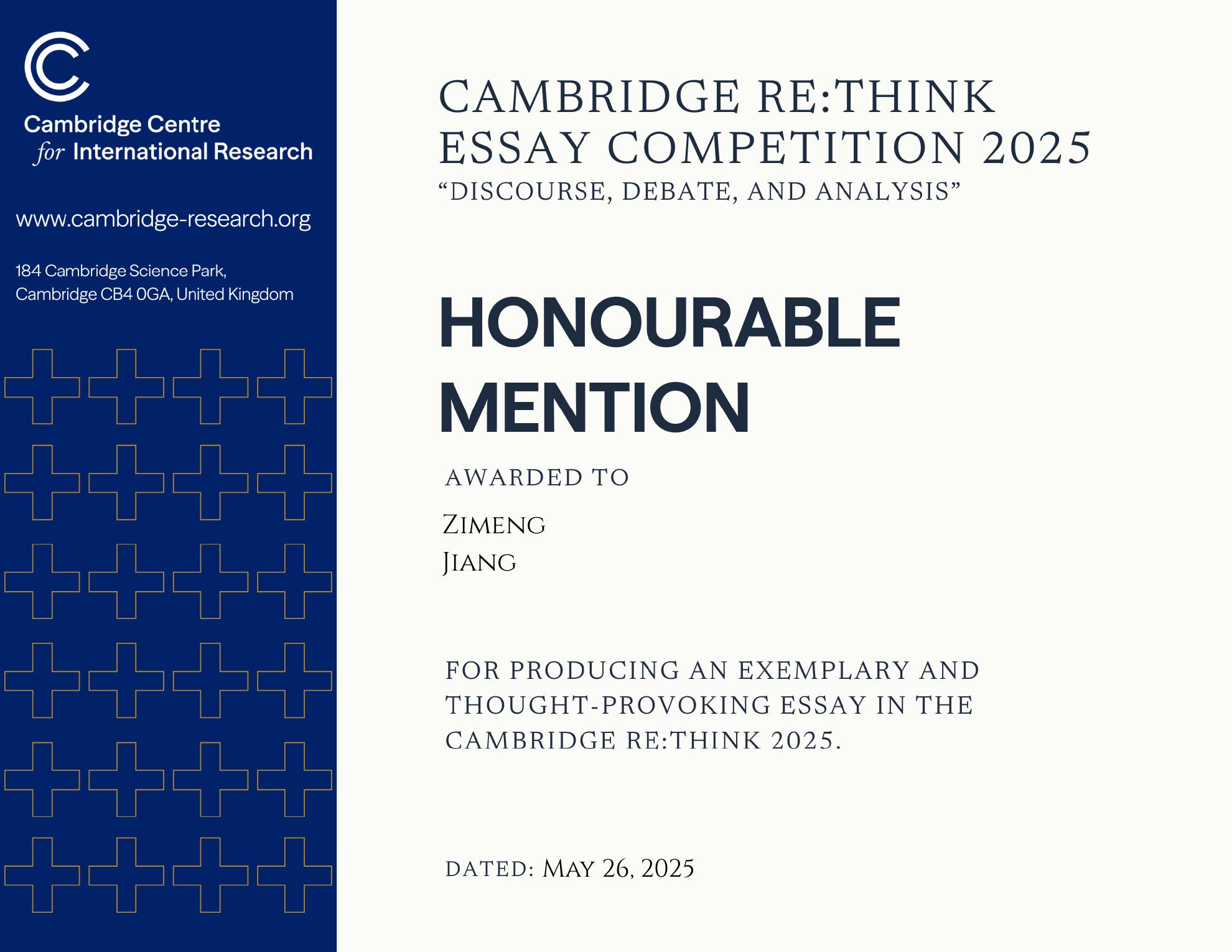
Writing is where observation becomes inquiry. Across culture, media, ethics, sustainability, and public life, I use research to question familiar categories, examine competing perspectives, and understand the systems that shape how people and communities are represented.
Project 1
Negotiating “Chineseness” in Global Fashion
To be added
When Chinese designers enter the global fashion system, who decides what counts as recognizably “Chinese”? This paper compares the work and reception of Zhaoyi Yu and Ao Yes, examining the gap between designers' intentions and the identities assigned to them by media and audiences.
Through discourse and visual analysis, I argue that “Chineseness” is not a fixed aesthetic category, but a negotiated label shaped by cultural expectation, global fashion institutions, and unequal power over interpretation.
✂
Project 2
Cancel Culture, Public Discourse, and Moral Responsibility
This essay examines the tension between freedom of expression and social accountability in digitally networked public life. Drawing on John Stuart Mill and William Clifford, I compare China's Xianzi #MeToo case with the U.S. case of Justine Sacco.
Rather than asking whether cancel culture is simply right or wrong, I consider how evidence, scale, context, and collective punishment shape public moral judgment — and how social media changes both the speed and consequences of that judgment.
Human Rights Field Report — The Section 377 Case in India
This collaborative field report examines India's Section 377 case as both a landmark legal transformation and an unfinished human-rights struggle. Tracing the movement from a colonial-era law to the 2018 Navtej Singh Johar judgment, we analyzed how courts, NGOs, public-health actors, activists, families, and LGBTQ+ communities contributed to decriminalization.
We also designed a rights-based fieldwork framework combining legal analysis, interviews, questionnaires, and public-event observation, with particular attention to consent, privacy, representation, trauma, and the communities often excluded from dominant narratives.
Sports mega-events are often celebrated through spectacle, but their environmental costs extend far beyond the stadium. In this interdisciplinary study, my team examined how host-city selection, infrastructure, travel, construction, and event operations contribute to environmental impact.
Comparing the Olympic Games and the Super Bowl, we combined life-cycle assessment with quantitative modeling to identify major drivers of environmental burden and propose more sustainable approaches to evaluating future host cities.